
If you've lost most or all of your teeth -or you're facing that prospect - All-on-4 dental implants are almost certainly the most efficient, cost-effective, and permanent solution available. This guide covers everything: what the procedure involves, who it suits, what it costs in Turkey versus the UK and USA, what to expect during surgery and recovery, and the questions most patients ask before they book
💡 All-on-4 dental implants All-on-4 dental implants use just four strategically placed titanium implants to support a complete fixed arch of prosthetic teeth - upper or lower jaw. At Myra Dental in Antalya, the procedure starts from £1,600 per arch, compared to £12,000-£24,000 in the UK and $15,000–$30,000 in the USA. You can leave the clinic with functional teeth within 24-48 hours of surgery. |
What Is an All-on-4 Dental Implant?
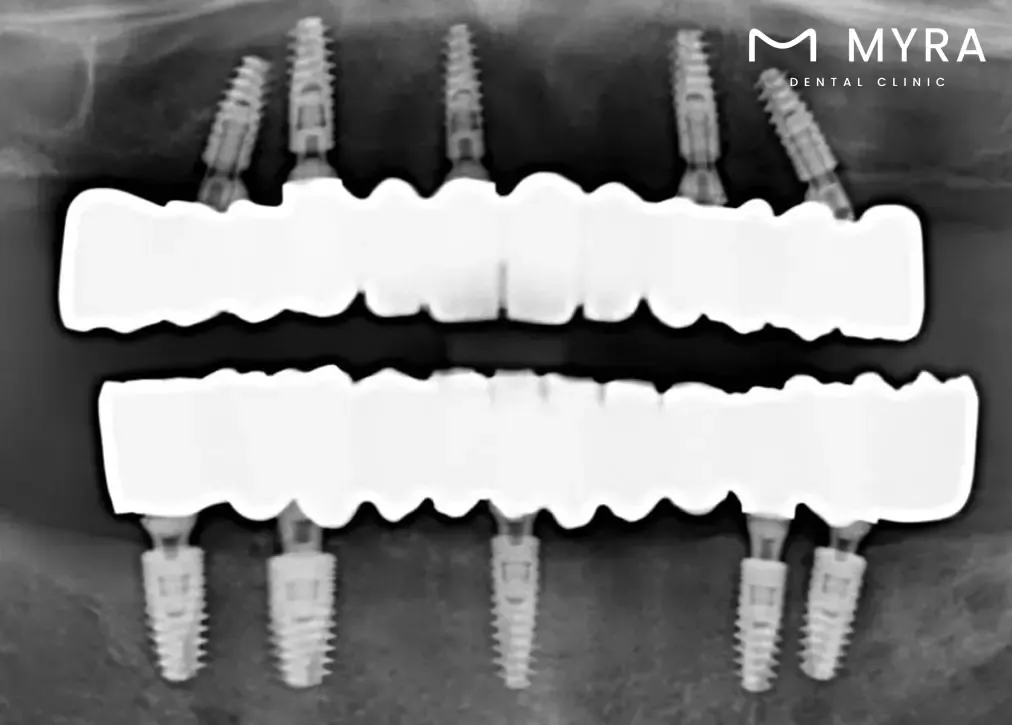
All-on-4 is a full-arch dental restoration technique in which four titanium implants are placed into the jawbone at precise angles to support a complete set of prosthetic teeth. The system was developed by Nobel Biocare and has been used clinically for more than two decades, with consistently high success rates across that period.
The name is literal: all of the teeth in one arch are supported on four implants. The two front implants are placed vertically in the area of highest bone density. The two rear implants are angled up to 45 degrees this tilted placement maximises contact with available bone, eliminates the need for bone grafting in most patients, and creates a stable four-point foundation for the fixed bridge.
The prosthetic arch - typically made from zirconia or high-strength acrylic is fixed to the implants. Unlike dentures, it cannot be removed by the patient. It functions like natural teeth: you eat with it, speak with it, and clean it the same way.
How All-on-4 differs from replacing teeth individually A single tooth implant replaces one root with one titanium post. Replacing a full arch of 10–14 teeth that way would require 10–14 implants, multiple surgeries, and a treatment timeline measured in years. All-on-4 achieves the same fixed, permanent result with four implants, one surgical appointment, and teeth fitted within 24–48 hours. |
All-on-4, All-on-6, and All-on-8 Which System Is Right for You?
The All-on-4 system is the most widely used full-arch restoration, but All-on-6 and All-on-8 variants exist for patients who need additional support. The right system depends on your bone density, degree of tooth loss, and bite force requirements.
System | Implants | Placement Position | Teeth Supported | Best For |
|---|---|---|---|---|
| All-on-4 | 4 | Lateral–premolar (tilted posterior) | Up to 10 teeth | Most common; lowest cost; suitable for most patients |
| All-on-6 | 6 | Central–canine–second premolar | Up to 12 teeth | Greater stability; better for higher bite force / more bone loss |
| All-on-8 | 8 | Central–canine–premolar–molar | Up to 14 teeth | Maximum support; no bone grafting required in most cases |
All-on-4 suits the widest range of patients, costs less, and involves a simpler surgical procedure. Most patients at Myra Dental receive All-on-4 because their bone structure supports it comfortably.
All-on-6 is the better choice when a patient has significant bone loss in the posterior jaw, or when heavier chewing force demands extra support. The two additional implants spread the load more evenly across the arch - particularly useful for patients who grind their teeth or who need a longer bridge spanning 12 teeth. Your Myra Dental implantologist will recommend All-on-6 if the 3D CT scan shows that four implants cannot achieve the stability threshold required for long-term success.
**All-on-8** is reserved for the most complex cases. Patients with severe bone loss across the full arch - where even angled placement cannot find enough bone for four or six implants benefit from eight-point support. All-on-8 also allows the fullest arch reconstruction (up to 14 teeth) and distributes occlusal force across the widest footprint. The trade-off is a longer surgical appointment, higher cost, and a more involved recovery. Myra Dental recommends All-on-8 in roughly 10–15% of full-arch cases.

How the All-on-4 Procedure Works Step by Step
All-on-4 is completed across two phases: the surgical day and the final fitting. For patients choosing same-day implants, both can be condensed into a single trip to Turkey.
Phase 1 : Consultation and Planning
Before any surgery, your Myra Dental implantologist conducts a full oral health assessment including 3D cone-beam CT imaging (CBCT). The CT scan maps your bone density, jaw structure, nerve positions, and sinus proximity in three dimensions the data that determines exact implant positioning. A personalised treatment plan is produced from this scan before you commit to travelling.
Phase 2 : Implant Surgery (Day 1 or 2)
The surgical procedure takes 2–4 hours and is performed under local anaesthetic. IV sedation is available for anxious patients. The steps in sequence:
- Any remaining compromised teeth are extracted.
- The four titanium implant posts are placed into the jaw using a computer-guided surgical guide derived from the CT scan this significantly reduces human error and improves placement accuracy.
- The posterior implants are angled to maximise bone contact and create a rigid four-point foundation.
- A temporary fixed bridge (acrylic or PMMA) is attached to the implants the same day you leave the clinic with functional teeth.
Phase 3 : Osseointegration (3–6 Months)
Over the following 3–6 months, the titanium implant posts fuse with your jawbone through a process called osseointegration. During this period, you wear the temporary bridge. It is fully functional you can eat and speak normally but it is provisional.
Phase 4 : Final Prosthesis Fitting
Once osseointegration is confirmed, the final permanent bridge is fitted. At Myra Dental, the final restoration is typically zirconia chosen for its strength, natural translucency, and resistance to staining. This bridge is designed and milled using CAD/CAM technology for a precise, custom fit.
For patients who choose immediate load implants and have suitable bone density, a higher-quality provisional bridge can be fitted on the surgical day, reducing the total number of visits to Turkey required.
→ How many trips to Turkey will I need? For standard All-on-4: two trips one for surgery and temporary bridge, one for final fitting 3–6 months later. Many patients combine the second visit with a holiday. For immediate load cases: one extended trip (5–7 days) if final teeth can be fitted during osseointegration confirmation. Your Myra Dental treatment coordinator will confirm which applies to your case during the free remote consultation. |
All-on-4 vs Traditional Dental Implants - Key Differences
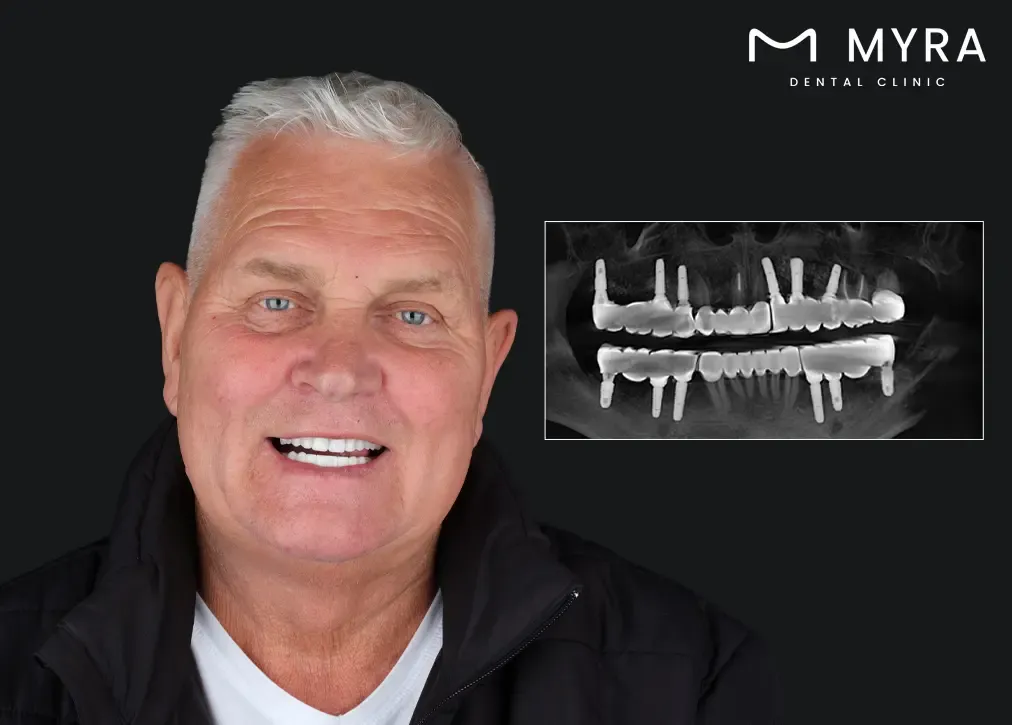
Patients comparing All-on-4 to conventional individual implants are usually deciding between two fundamentally different treatment strategies. This comparison focuses on the factors that matter most for full-arch restoration.
Factor | All-on-4 | Traditional Implants |
|---|---|---|
| Implants required | 4 (full arch) | 1 per missing tooth (8–12+ for full arch) |
| Treatment timeline | Teeth in 24–48 hours | 6–18 months across multiple stages |
| Bone grafting | Rarely needed (angled placement) | Often required; adds cost and time |
| Cost (full arch) | £1,600–£3,400 in Turkey | £10,000–£50,000 depending on teeth replaced |
| Candidacy | Suitable for significant bone loss | Requires good bone density throughout |
| Longevity | Up to 25 years (implant posts) | 20–25+ years (per implant) |
The clinical case for All-on-4 over traditional full-arch implants is not just about cost. The angled posterior implants allow Myra Dental to work with the bone you have - including areas of moderate bone loss - without the additional surgery, recovery time, and expense of bone grafting that conventional placement often requires.
Who Is a Good Candidate for All-on-4 Dental Implants?
All-on-4 is designed specifically for patients with significant tooth loss or who are facing it. Ideal candidates share most or all of the following:
- Have lost most or all teeth in one or both arches —through decay, gum disease, trauma, or extraction
- Have been told they need full dentures and want a fixed, permanent alternative
- Have some degree of jawbone loss (All-on-4 is often viable where individual implants are not)
- Are in adequate general health to undergo a 2–4 hour surgical procedure under local anaesthetic
- Have healthy gums, or gum disease that can be treated before implant placement
- Are non-smokers, or prepared to stop smoking for the healing period (smoking significantly increases failure risk)
Age is not a disqualifying factor. Myra Dental has successfully placed All-on-4 implants in patients in their 70s and 80s. The assessment focuses on bone structure, gum health, and general medical fitness, not age.
Who may not be suitable:
- Active, uncontrolled gum disease (must be treated first)
- Insufficient jawbone density even for angled placement (may require All-on-6 or All-on-8, or bone grafting)
- Uncontrolled systemic conditions such as unmanaged diabetes or autoimmune conditions that impair healing
- Patients on certain medications (bisphosphonates, immunosuppressants) requires case-by-case assessment
Not sure if you qualify? Myra Dental offers a free remote treatment planning consultation. Send your dental X-rays or CBCT scan and receive a written assessment of your candidacy, the recommended system (All-on-4, 6, or 8), and an all-inclusive price quote before you book a flight. |
All-on-4 Cost in Turkey vs UK vs USA - 2026 Prices
The cost of All-on-4 dental implants in Turkey is 60–85% lower than equivalent treatment in the UK or USA. This is not a reflection of quality , it reflects Turkey's lower operating costs, favourable currency exchange, and a competitive dental tourism market that keeps pricing honest.
Treatment | Myra Dental Turkey | UK Average | USA Average |
|---|---|---|---|
| All-on-4 (per arch) | £1,600–£3,400 | £12,000–£24,000 | $15,000–$30,000 |
| All-on-6 (per arch) | £2,960–£5,600 | £15,000–£25,000 | $18,000–$35,000 |
| All-on-8 (per arch) | £8,000–£16,000 | £20,000–£35,000 | $20,000–$42,000 |
| Bone graft (if needed) | From £150 | £400–£4,000 | $500–$3,000 |
* Myra Dental prices include implant posts, abutments, and the zirconia porcelain bridge. Consultation and 3D CT scan are free. Any additional procedures (bone graft, sinus lift, extractions) are quoted separately and transparently before you confirm treatment. Prices correct March 2026.
🔗 For a full price breakdown All-on-4, All-on-6, All-on-8, implant brands, and what's included See the see the full price breakdown for a complete treatment price guide, brand options (Straumann vs standard), what the Myra Dental package includes, and a country-by-country cost comparison. |
Why is All-on-4 so much cheaper in Turkey?
The implant brands, titanium grade, zirconia crown quality, and surgical protocols at Myra Dental are the same as those used in top UK and US clinics. What differs is operating cost. Clinic rent, staff salaries, and medical VAT in Antalya are a fraction of London or New York. Myra Dental's high volume of international patients also allows investment in technologies - 3D CT scanners, CAD/CAM milling, computer-guided surgery - that many smaller UK clinics cannot justify.
For most UK patients, the total cost of All-on-4 in Turkey- including return flights, hotel, and treatment - is still 50–70% less than the UK dental quote for the procedure alone.
Key Benefits of All-on-4 Dental Implants
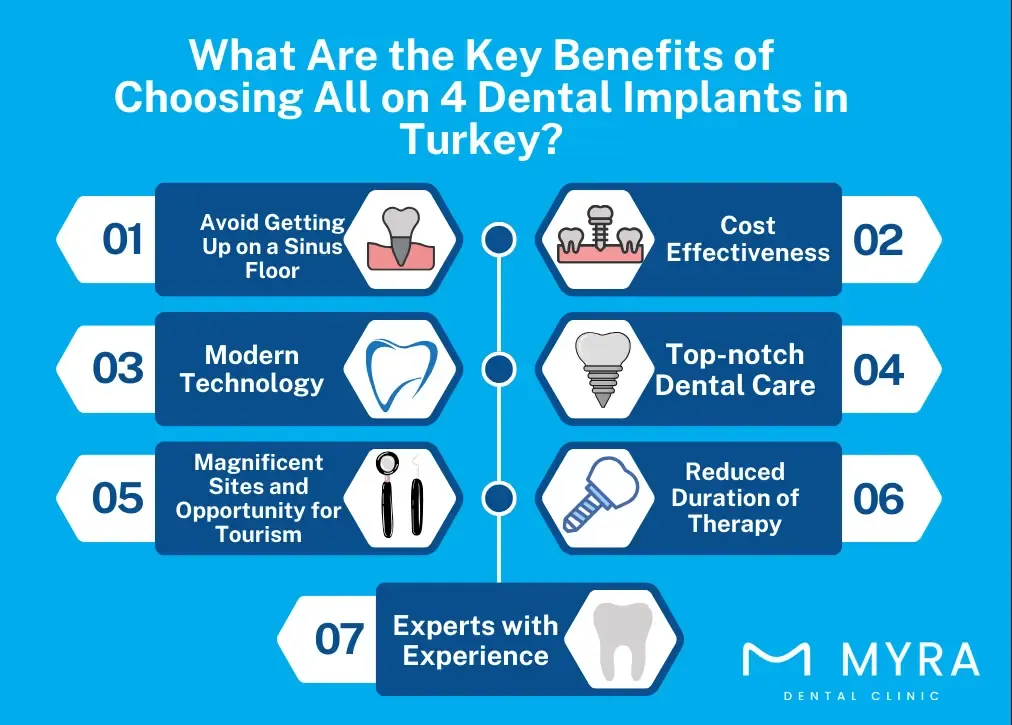
- Fixed and permanent : Fixed and permanent cannot be removed; no adhesives, no slippage, no daily removal
- Teeth in 24–48 hours : Teeth in 24–48 hours — temporary bridge fitted the same day as surgery
- Bone loss friendly : Bone loss friendly - angled posterior implants work with existing bone; grafting avoided in most cases
- Natural look and function — Natural look and function - eat, speak, and smile without restriction
- Jawbone preservation — Jawbone preservation - implants stimulate the bone, preventing the further loss that follows tooth extraction
- Long lifespan - Long lifespan - implant posts designed to last 25+ years; prosthetic bridge replaceable if needed after 15–20 years
- Fewer implants - Fewer implants than replacing teeth individually - simpler surgery, faster treatment, lower cost
- High success rate -High success rate - 96–98% across published clinical studies; comparable to individual implant success rates
Limitations and Downsides -What to Know Before You Decide
All-on-4 has genuine advantages for the right patient, but it also has limitations that any honest guide must address.
- Not ideal for patients with very heavy bite forces - the four-implant system distributes load efficiently but is not designed for extreme occlusal stress. All-on-6 may be recommended for such patients.
- The bridge is a single unit -any repair or replacement affects the entire arch. Individual implants can be treated in isolation if a problem arises.
- Implant failure risk -though rare (2–4%), if one implant fails the entire system is affected. This is the most significant structural risk specific to All-on-4.
- Requires two trips to Turkey for standard cases the osseointegration period means a return visit for the final fitting.
- Prosthetic teeth wear over time the zirconia or acrylic bridge, while durable, is not permanent and may need replacement after 15–20 years. The implant posts themselves are designed to be lifetime fixtures.
- Adjustment period — speech and eating habits require a short acclimatisation period as patients adjust to the new bite.
What Type of Dentist Performs All-on-4 Implants?
All-on-4 should be performed by an implantologist — a dentist who has completed postgraduate specialisation in implant dentistry. At Myra Dental, All-on-4 procedures are carried out exclusively by implant specialists with documented experience across hundreds of arch restorations. This matters for a specific reason: All-on-4 requires precise three-dimensional positioning of the angled posterior implants. The margin for error is small, and the consequence of misplacement — stress on the adjacent implants, prosthetic misfit, long-term failure risk — is significant.
When evaluating any clinic for All-on-4, ask:
- How many All-on-4 procedures has this implantologist performed annually?
- Does the clinic use 3D CT-guided surgical planning for implant placement?
- Are before-and-after cases from real patients available to review?
- What is the clinic's protocol if an implant fails within the first year?
Myra Dental's implantologists place over 1,000 implants per year, use computer-guided surgery as standard, and provide a documented aftercare and complication protocol for all international patients.
Is the All-on-4 Procedure Painful?
The surgery itself is performed under local anaesthetic — the jaw is fully numbed before any incisions are made. Most patients report being surprised by how little discomfort they experience during the procedure. IV sedation is available for patients with significant dental anxiety.
Post-operatively, some swelling, bruising, and tenderness around the implant sites is normal and expected. This typically peaks at 48–72 hours and resolves within 5–7 days. Myra Dental prescribes appropriate pain management and anti-inflammatories before you leave the clinic. Most patients manage post-operative discomfort with the prescribed medication and over-the-counter analgesics.
The discomfort profile of All-on-4 is generally lighter than patients anticipate, and lighter than many tooth extractions. The vast majority of patients are comfortable enough to fly home within 3–5 days of surgery.
Success Rate and Longevity of All-on-4 Implants
Published clinical data places the All-on-4 success rate at 96–98% across 10-year follow-up studies. Myra Dental's success rate for All-on-4 procedures is consistent with this range. The rate measures implant integration (osseointegration) — the most critical phase of the procedure.
The implant posts themselves are designed to be permanent fixtures — titanium integrates with bone over decades and does not degrade. The prosthetic bridge (the teeth you can see) is the component that wears over time. A zirconia bridge at Myra Dental is expected to last 15–20+ years before replacement may be needed. At that point, the replacement is the bridge only — the implant posts beneath remain in place.
Factors that affect long-term success:
- Oral hygiene — daily cleaning around the bridge and implant margins is essential; failure to maintain hygiene leads to peri-implantitis (inflammation around the implant)
- Smoking — significantly increases failure risk both during osseointegration and long-term; patients who smoke are strongly advised to stop before and during the healing period
- Bruxism (teeth grinding) — places excessive load on the implant system; patients with bruxism may be prescribed a night guard
- Regular dental check-ups — Myra Dental recommends 6-monthly professional cleaning and implant assessment, whether at Myra Dental or a local dental practice at home
Post-Operative Care After All-on-4 Surgery
Following surgery at Myra Dental, you will be given a written implant aftercare protocol. The key requirements for the first 6–12 weeks:
Diet
A soft diet is essential during the initial healing period. Hard, crunchy, or chewy foods place undue force on the implants before osseointegration is complete. Myra Dental provides specific dietary guidelines. Foods to avoid in the first 6 weeks include raw vegetables, hard bread, nuts, and meat on the bone. A return to a normal diet is phased in as healing progresses.
Oral Hygiene
All-on-4 implants require cleaning in the same way as natural teeth — twice daily with a soft-bristled toothbrush and non-abrasive toothpaste. Interdental brushes or implant-specific floss is used to clean beneath the bridge at the implant margins. An antibacterial mouthwash (as prescribed) reduces infection risk in the early healing phase. Myra Dental's aftercare team will demonstrate the correct cleaning technique before you leave the clinic.
Activity and Recovery Timeline
- Days 1–3: Rest; avoid strenuous physical activity; expect peak swelling and tenderness
- Days 4–7: Swelling subsides; most patients are comfortable enough to fly home
- Weeks 2–6: Soft diet continues; gentle physical activity resumed
- Months 3–6: Osseointegration completes; return visit for final bridge fitting
- Ongoing: 6-monthly check-ups; standard dental hygiene routine
What to Avoid
- Smoking — for at minimum 3 months post-surgery (ideally permanently)
- Alcohol — for the first 72 hours post-surgery
- Hard foods — throughout the osseointegration period
- Vigorous rinsing or spitting — in the first 24 hours
- Contact sports — until the surgical sites are fully healed
Is the All-on-4 Bridge Removable?
No. All-on-4 dental implants are a fixed, non-removable restoration. The prosthetic bridge is attached directly to the four titanium implant posts, which are anchored into your jawbone. Once the implants have integrated with the bone, neither the posts nor the bridge can be removed without clinical intervention — and there is no clinical reason to remove them for routine cleaning or daily use.
This is one of the primary advantages over traditional dentures: no removal for cleaning, no adhesives, no risk of slippage during eating or speaking. The All-on-4 bridge is cleaned in place, exactly like natural teeth.
Technology Used at Myra Dental for All-on-4
The precision of All-on-4 outcomes is directly tied to the technology used in planning and placement. Myra Dental uses:
- 3D cone-beam CT (CBCT) scanning — 3D cone-beam CT (CBCT) scanning — full three-dimensional mapping of jaw anatomy, bone density, nerve locations, and sinus proximity before any surgical planning begins
- Computer-guided surgical planning — Computer-guided surgical planning — implant positions are planned digitally from the CT data, then executed using a surgical guide fabricated to that exact plan
- CAD/CAM prosthetics manufacturing — CAD/CAM prosthetics manufacturing — the final bridge is designed digitally and milled from a single block of zirconia, producing a precise custom fit without manual laboratory error
- All-on-Bar option — All-on-Bar option — for patients requiring maximum long-term durability, a milled titanium bar structure can be attached to the implants beneath the prosthetic bridge, protecting the implants from bridge-related stress and allowing the bridge to be replaced independently
Next Steps: Free Treatment Plan and Price Quote
The fastest way to find out whether you're a candidate for All-on-4, All-on-6, or All-on-8 — and what it will cost at Myra Dental - is a free remote consultation. Send your dental X-rays or CBCT scan to Myra Dental's treatment planning team and receive a written assessment, a recommended treatment plan, and an all-inclusive price before you book a flight.
There is no obligation and no cost for the remote consultation. If you proceed, Myra Dental's international patient team handles everything from appointment scheduling to accommodation recommendations
Frequently Asked Questions About All-on-4 Dental Implants in Turkey
Share your phone number with us, we'll call you!